
Rights of light and daylight & sunlight in London
London has one regional plan and 33 local planning authorities, each with its own approach to daylight and sunlight, and land values high enough that rights of light can decide what a site is worth. We advise developers and design teams on both: how a scheme is likely to be judged in the borough it sits in, and what the neighbouring rights mean for the site.
- 33
- local planning authorities, each with its own approach to daylight and sunlight
- D6
- the London Plan policy asking for daylight and sunlight “appropriate for its context”
- D9
- the policy under which boroughs identify where tall buildings may be appropriate
The planning context in London
Policy D6 of the London Plan asks that development provides sufficient daylight and sunlight to new and surrounding housing that is “appropriate for its context”. Those last four words carry a great deal of weight. The Mayor’s Housing SPG (2016) asks for an appropriate degree of flexibility in applying the BRE Guidelines, particularly on higher density sites in opportunity areas, town centres, large sites and accessible locations, and for effects to be weighed against comparable residential typologies in the area and across London.
“appropriate for its context”
The London Plan (2021), Policy D6
Inspectors have taken the same line. At the Whitechapel Estate appeal in 2018, the inspector found that blanket application of the BRE optimum standards, which are best achieved in relatively low-rise, well-spaced layouts, was not appropriate. Nationally, the National Planning Policy Framework (NPPF) was rewritten in August 2026 and no longer carries its earlier wording on a flexible approach. Policy P3 now asks that development does not give rise to “an unacceptable level of access to daylight and sunlight for neighbouring residents and occupiers”, which leaves what is acceptable to be judged in its context.
That flexibility is not automatic, however. Each borough applies it through its own amenity policy, and the context argument has to be evidenced: what the existing street already achieves, what comparable consented schemes retain, and why the effects that remain are acceptable. That part of the assessment usually decides the outcome.
What shapes the daylight case in London
- Existing terrace
- Proposed tall buildings
- The nearest window sees sky only above this line
Illustrative only. Not to scale, and not a real site or result.
-
Tall buildings and clusters
Policy D9 asks boroughs to identify where tall buildings may be appropriate, and on those sites the effect on neighbouring homes is usually one of the issues debated at committee.
-
Dense historic streets
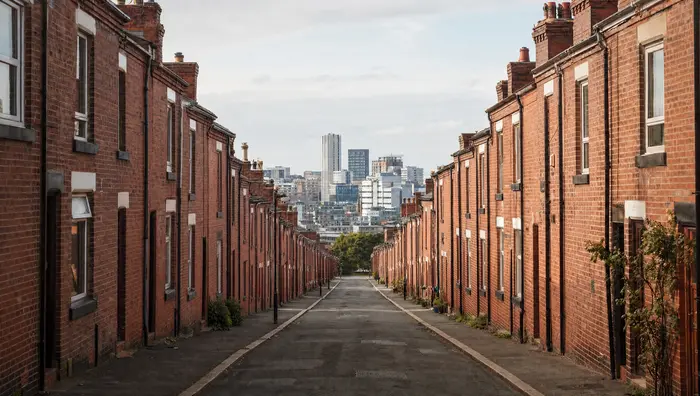
Victorian and Edwardian terraces often sit well below the BRE targets already, so the comparison that matters is with what the street achieves today rather than with a suburban benchmark.
-
Estate regeneration
Existing residents can be both the neighbours being assessed and the occupiers of the new homes, often across several phases, so each phase needs testing against the ones before it.
-
Internal daylight
Compact single-aspect units, co-living and student schemes are tested against BS EN 17037, and the Mayor’s housing design guidance favours dual aspect homes.

Rights of light in London
A private legal right held by neighbouring owners, enforced by agreement or through the courts, and unaffected by planning permission.
-
The law
A right of light is a private legal right held by a neighbouring owner, usually acquired after twenty years of uninterrupted enjoyment, and it is not removed by planning permission. The law is the same in London as anywhere else in England and Wales, however the exposure is not.
-
Why the exposure is greater
In London it is usually greater for three reasons. Land values mean the area at stake on the upper floors is worth more. Dense ownership means a single scheme can affect many neighbours, each of whom has to be dealt with separately. And commercial windows can hold rights of light just as homes can, so in the City and the West End offices are often among the most significant neighbours.
-
Section 203
Where the land is held or acquired by a qualifying authority, appropriation and Section 203 of the Housing and Planning Act 2016 may be worth considering, though the statutory conditions have to be met. It often arises on estate regeneration, where a council is both landowner and planning authority.
Earlier work in London
Before founding MDX, Daniel Maddox worked on these London schemes at previous practices.
About MDX- Battersea Power Station
- Cross Harbour District Centre
- Paddington Green Police Station
- 55 Bishopsgate
- Elephant & Castle tube station and shopping centre
London: common questions
Do I need both a rights of light and a daylight and sunlight assessment in London?
Often, yes. They answer different questions. Daylight and sunlight is a planning matter, judged by the borough against the BRE Guidelines and Policy D6 of the London Plan. A right of light is a private legal right held by a neighbouring owner, and planning permission does not remove it. Most central London sites need both considered.
Which London boroughs do you cover?
All of them. London has 33 local planning authorities, and each applies the flexibility in the guidance through its own amenity policy, so we look at the borough’s policy before the work is scoped.
Do offices and other commercial buildings have rights of light?
They can. Commercial windows can hold rights of light just as homes can, so in the City and the West End offices are often among the most significant neighbours.
Work in London
The services behind this page - Wyvil Court, Vauxhall A 185-room aparthotel replacing a 1990s office building on the corner of Wyvil Road and Trenchold Street, assessed for daylight, sunlight and overshadowing against its neighbours and the Wyvil School playground.
- Great North Leisure Park, North Finchley Internal daylight and overshadowing assessment for the redevelopment of an 11-acre leisure park in North Finchley, delivering around 1,485 homes, a new leisure centre and lido.
Daylight & Sunlight
A planning consideration, assessed against BRE 209 (2022) and BS EN 17037 and decided by the local planning authority.
Overshadowing & Solar
Also a planning matter: sunlight to gardens, courtyards and public realm, tested separately again from window daylight.
Development Risk
Pre-acquisition appraisal and scheme optimisation, before the land is committed.
Other locations
Sources for this page
- National Planning Policy Framework (August 2026), Policy P3: living conditions and pollution.
- Mayor of London, The London Plan (March 2021), Policies D6 and D9.
- Mayor of London, Housing Supplementary Planning Guidance (2016), paragraphs 1.3.45 and 1.3.46.
- Whitechapel Estate appeal, APP/E5900/W/17/3171437, decided 21 February 2018.
- Building Research Establishment, Site Layout Planning for Daylight and Sunlight: A Guide to Good Practice (BR 209, 2022).
Plan status as at October 2026. Local policy changes, so check the current position for any particular site.
BRE 2022 daylight and sunlight guidance explained
What is a rights of light injunction?
Have a site in London?
Send us the location and a massing model, and we will come back within 24 hours with a preliminary review of both the rights of light and the daylight and sunlight position.
Or call 020 8191 4207
- Send us the site A location and whatever drawings or massing you have.
- A preliminary review of the site within 24 hours Free of charge, with no obligation to instruct.