Party wall and neighbourly matters, managed alongside the rest of your development strategy.
Most developments close to a boundary need to deal with their neighbours under the Party Wall etc. Act 1996, and many also need access, scaffold or crane oversail licences. We serve the notices, agree the awards and negotiate the licences on fixed fees, and coordinate that work with any rights of light or daylight and sunlight position on the same scheme.

- 1 month
- Sections 1 and 6
- Notice for a new wall on the boundary, or for excavation near a neighbour.
- 2 months
- Section 3
- Notice for work to a party wall or other party structure.
- 14 days
- To consent
- After that a dispute is deemed to have arisen and surveyors are appointed.
- 3 / 6 m
- Section 6
- The excavation distances from a neighbouring structure.
What the Party Wall etc. Act covers
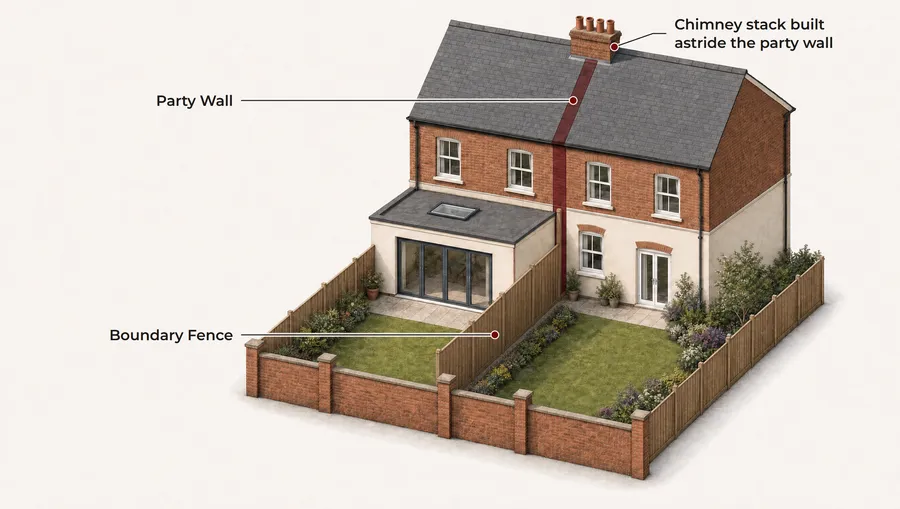
The Act gives a building owner the right to carry out certain works that affect a neighbour, provided the neighbour is properly notified and the procedure in the Act is followed. In return it gives the adjoining owner protection, through an award that records how the work will be done and how any damage will be made good.
Three types of work bring the Act into play:
- New walls on the boundary. Building a new wall on or astride the line of junction with a neighbour’s land, which needs one month’s notice under Section 1.
- Work to a party structure. Cutting into, raising, underpinning, demolishing or rebuilding a party wall or other party structure, which needs two months’ notice under Section 3.
- Excavation near a neighbour. Excavating within three metres of a neighbouring structure and below its foundations, or within six metres where the excavation would cut a line drawn down at 45 degrees from the bottom of those foundations. This needs one month’s notice under Section 6.
Once notices are served, a neighbour has fourteen days to consent. If they do not, a dispute is deemed to have arisen and surveyors are appointed, either one agreed surveyor acting for both owners or one surveyor for each, who between them select a third surveyor in case they cannot agree. The surveyors then agree an award, usually with a schedule of condition of the neighbouring property attached, before the notifiable work starts.
The building owner is normally responsible for the reasonable costs of the process, including the fees of the neighbour’s surveyor. That is a cost that should be budgeted for at the outset rather than discovered once notices are out.
What it does not cover
The Act gives limited rights of entry to carry out notifiable work. It does not, however, give a developer the right to oversail a neighbour’s land with a crane jib, or to place scaffolding on it for the wider construction. Those need the neighbour’s agreement, usually in a licence. The neighbour is under no obligation to agree, and where they do they can attach conditions, including payment or reciprocal rights for their own future development.
A party wall award also says nothing about rights of light or daylight and sunlight. A scheme can have every award in place and still face a rights of light claim from the same neighbour, which is why we recommend treating the two together.
Notices, awards and licences, in a single proposal.
Most schemes need several of these, and we scope them together in a single proposal with fixed fees, so the cost is known before notices go out.
Party wall notices and awards
Identifying the adjoining owners, including leaseholders, from HM Land Registry, preparing and serving the notices, and agreeing an award with each neighbour’s surveyor. Fixed fees per award.
Schedules of condition
A recorded condition of the neighbouring property before work starts, so any later claim for damage is assessed against evidence rather than recollection. Fixed fee per building.
Access, scaffold and crane oversail licences
Opening discussions with the neighbour, agreeing heads of terms and, where you prefer, drafting and agreeing the licence itself with the neighbour’s surveyor rather than passing it to solicitors.
Security for expenses
Advice and negotiation where a neighbour asks for money to be held as security against the works. Neighbours are using this provision more often, and the sum is negotiable.
Budgets for the neighbours’ advisers
A realistic budget for the adjoining owners’ surveyors, and any checking engineer, set out in our proposal, with steps to keep it down, such as one engineer acting for several neighbours where possible.
Damage and close-out
Re-inspection once the work is complete, and resolving any damage under the Act at the hourly rates set out in our proposal.
- Notices prepared and served on every adjoining owner, freeholders and registered leaseholders alike
- An award agreed with each neighbour, with a schedule of condition of their property
- Access, scaffold or crane oversail licences, from heads of terms to the agreed licence where you prefer
- A fixed fee for our work, and a budget for the neighbours’ surveyors set out at the start
- The site address
- The proposed drawings or a stage report
- The intended programme and start date
- The structural engineer’s proposals for foundations and demolition, where available
Not all of this is needed to start. A location and an outline of the scheme are enough for a first conversation.
One adviser for every conversation with the neighbours.
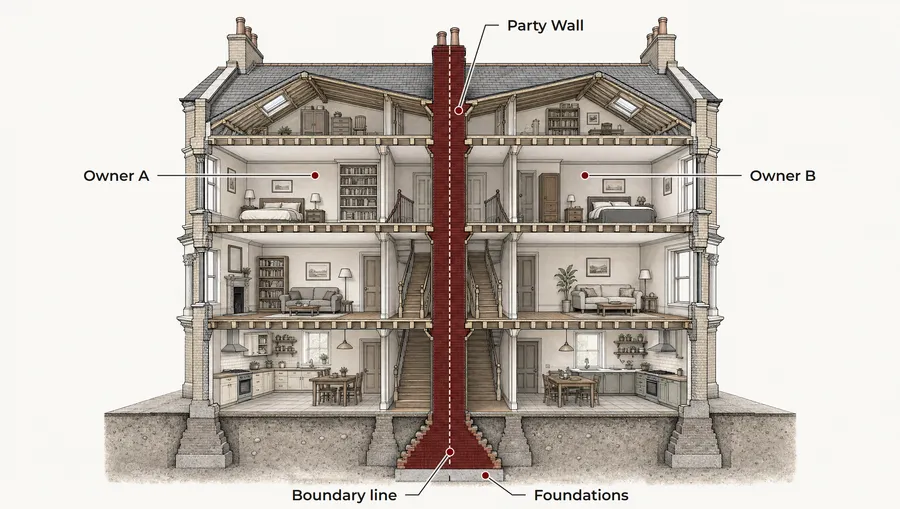
On most schemes the same neighbours are affected by the party wall process, the access arrangements and any rights of light or daylight and sunlight impact. Handled by separate advisers, those conversations can cut across each other.
The party wall notice is often the first formal contact with a neighbouring owner, and how and when a neighbour is approached can affect the rights of light insurance available to a scheme. Where we advise on both, the notices, licences and any rights of light discussion are planned as one sequence, and the neighbour deals with one consistent position from the developer’s side.
We are equally happy to act on party wall matters alone. The coordination is there where a scheme needs it.
Rights of lightWhen to start
The statutory notice periods are short, however agreeing awards with several neighbours, and licences with any of them, takes longer. We recommend serving notices at least two to three months before notifiable work starts, which allows time to agree the awards if the neighbours do not waive the notice period.
Not all of the information we ask for is needed to start. An address and an outline of the works are enough for a first view of which neighbours are likely to be involved.
- Pre-acquisition or feasibility Who the adjoining owners are, which works are likely to be notifiable, and whether scaffold or crane access will be needed. A cost and programme allowance for both.
- Design Notifiable works confirmed from the drawings and structural proposals, and access requirements identified with the contractor where one is appointed.
- Two to three months before start Notices served. Surveyors appointed. Licence discussions opened.
- Before start Schedules of condition taken, awards agreed and served, licences in place.
- During and after the works Liaison with neighbours and their surveyors, re-inspection on completion, and any damage resolved under the award.
If you have received a notice
We also act for neighbouring owners who have received a party wall notice, checking that the notice is valid, reviewing the proposed works and agreeing an award that protects the property. In most cases the building owner pays the reasonable costs of the neighbour’s surveyor.
Party wall: common questions
Do I need a party wall surveyor?
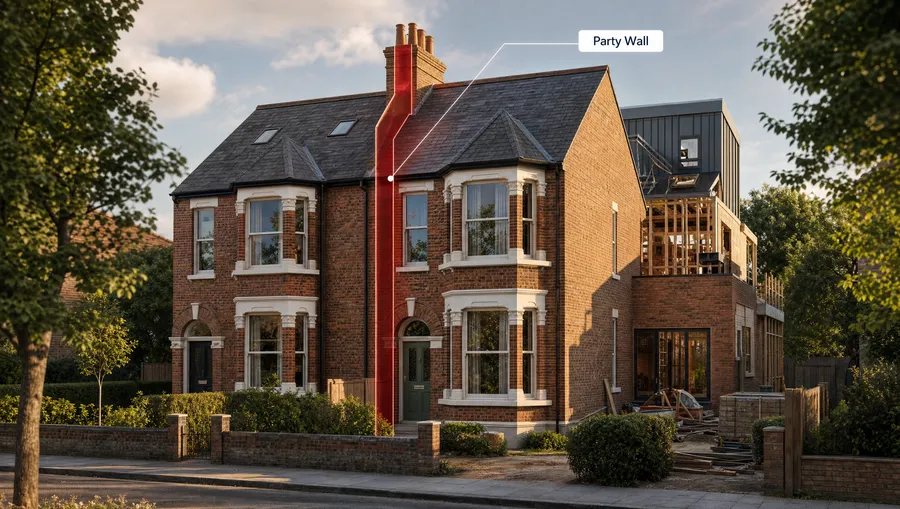
If your works fall within Section 1, 2 or 6 of the Act, you need to serve notice on the affected neighbours. If they consent in writing, no surveyor is needed for the award, although a schedule of condition is still sensible. If they do not consent within fourteen days, a dispute arises and surveyors have to be appointed. On development schemes that is the usual outcome.
Who pays the neighbour’s surveyor?
Normally the building owner, where the work is for the building owner’s benefit. The surveyors’ award sets out who pays what. We include a budget for the neighbours’ surveyors in our proposal so it is not a surprise.
Can a neighbour stop the works?
Not where the Act applies and its procedure is followed. A neighbour can dissent and appoint a surveyor, and the award then governs how the work is carried out, however it does not prevent it. Access outside the Act, such as scaffolding or crane oversail, is different, because it needs the neighbour’s agreement.
How much notice do I need to give?
One month for a new wall on the boundary or for adjacent excavation, and two months for work to a party structure. A neighbour can agree to a shorter period. In practice we recommend serving notices two to three months before work starts, so the awards are agreed in time.
What is security for expenses?
Under Section 12 a neighbour can ask for money to be held as security before the work starts, to cover the risk of the work being left incomplete or of damage. The amount is negotiable and is usually held in an independent account and released in stages, on the signature of the surveyors, as the work is completed.
Can a neighbour refuse scaffolding or crane oversail?
Yes. Unless rights already exist between the properties, placing scaffolding on a neighbour’s land or swinging a crane jib over it needs their consent, and they can attach conditions. That is why access is worth raising early, before the programme depends on it.
Does a party wall award deal with rights of light?
No. A party wall award governs how notifiable work is carried out. Rights of light are a separate private right, enforceable through agreement or the courts, and are not affected by the award. See our rights of light page.
Send us the drawings and the programme.
We will tell you which neighbours are likely to need notices, whether access licences will be needed, and what the process should cost, including the neighbours’ surveyors.
Or call 020 8191 4207
- Send us the site A location and whatever drawings or massing you have.
- A preliminary review of the site within 24 hours Free of charge, with no obligation to instruct.